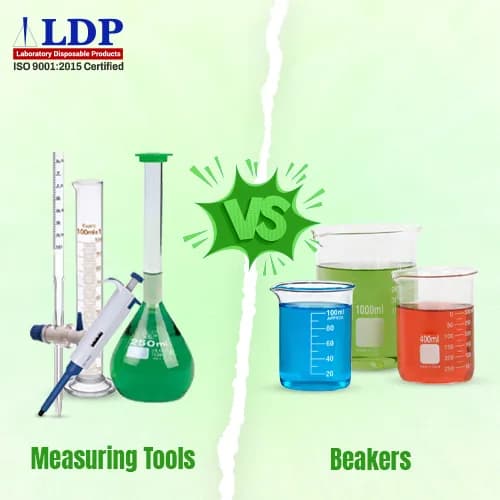
Laboratory Measuring Tools vs. Beakers: Accuracy, Use Cases, and Best Practices
On Saturday, 16 May 2026
In every scientific or industrial laboratory, the precision of measurement can make or break an experiment or analysis. Lab beakers and laboratory measuring tools are two of the most widely used laboratory equipment for volume measurement. A proper knowledge of lab beakers versus measuring cylinders, pipettes, and volumetric flasks is necessary to select the appropriate equipment.
This detailed guide will take you through uses of lab beakers, the benefits of accurate measuring tools for the lab, and discuss differences between lab beakers and measuring tools enabling you to know which lab equipment is best for measuring liquids accurately.
What Are Lab Beakers
Lab beakers are cylindrical vessels with a flat bottom, typically constructed of glass or plastic. They sometimes have a little spout (or “beak”) to facilitate pouring. Beakers are usually employed in mixing, heating, and holding liquids, but their markings for measurement are only approximate.

Normal Applications of Lab Beakers:
Mixing chemical solutions
Heating a liquid in a Bunsen burner or hot plate
Rough quantity estimation
Temporary storage of liquids
Though convenient, laboratory beakers are not ideal for accurate volume measurement, and scientists usually employ laboratory measuring tools in quantitative analysis.
What Are Laboratory Measuring Tools?

Laboratory measuring tools are a variety of laboratory equipment expressly intended to measure accurately in volume. Some of them are:
Pipettes (volumetric and graduated)
These tools are marked with precise calibrations to ensure accurate liquid measurement and are essential in chemical analysis, solution preparation, and quality control processes.
Lab Beakers vs Measuring Cylinders: Key Differences
While lab beakers and laboratory measuring tools may look similar at a glance, their functionality and accuracy levels are quite different.
Primarily, lab beakers are for general-use purposes, not for accuracy. They are perfect for heating, stirring, and holding liquids, but the markings for measuring volumes are only an estimate at best. The markings provide a rough approximation and should never be used when exact volume measurement is needed. This makes lab beakers perfect for quality work, but not quantitative analysis.
On the other hand, laboratory measuring instruments like graduated cylinders, volumetric flasks, and pipettes are specially designed to provide repeatable and precise volume readings. The instruments possess narrow and extended bodies that minimize the surface area of the liquid, thus enhancing the accuracy of measurements and reducing evaporation. Measuring instruments’ printed graduations are thoroughly tested to high standards, particularly in controlled environments such as chemical or pharmaceutical laboratories.
The other principal difference between lab beakers and measuring cylinders is in their shape and design. Beakers usually consist of a wide mouth and spout, which makes them simple to pour and stir solutions. Nevertheless, this wide mouth also contributes to greater evaporation and splashing, which might result in improper readings. Measuring cylinders, instead, possess a narrow neck and accurate graduation lines, which aid in guaranteeing that the precise volume is measured.
Additionally, the difference between a beaker and a measuring cylinder in laboratory use is seen in application. If the activity necessitates a precise volume to be taken—i.e., titration, preparation of formulation, or standard solution, then having precise measuring equipment for laboratory use is paramount. Beakers, even though they are harder and easier to use, are ideal when precision is a secondary factor.
Essentially, the most important difference between lab beakers and laboratory measuring tools is that beakers are designed for ease of use and versatility, whereas measuring tools are designed to measure volume accurately. Knowing when to employ each tool is crucial to ensuring the integrity and accuracy of laboratory findings.
Best Practices: Selecting Proper Lab Equipment for Volume Measurement
When choosing lab equipment for volume measurement, care should be taken to pair the instrument with the intended use:
Use Laboratory Measuring Tools When:
- You require precise and repeatable measurements
- Preparing standard solutions
- Quantitative experiments
- Measuring small volumes accurately
Use Lab Beakers When:
- You must mix solutions
- Approximation of rough volume is acceptable
- You’re transferring or temporarily storing liquid
Why Accuracy Matters
In analytical labs, even a 0.5 mL error can significantly alter results. That’s why laboratory tools used for accurate liquid measurement, such as pipettes and volumetric flasks, are engineered with high precision standards.
Whether you’re in pharmaceuticals, chemical processing, or research in academia, knowing which lab equipment is superior to use in measuring liquids accurately for consistency, reproducibility, and adherence to protocols matters.
Select LDP for Lab beakers and measuring instruments
Here at LDP (Laboratory Disposable Products), we provide various types of lab beakers and laboratory measuring instruments that save time and minimize the risks of contamination. These ones are perfect for:
High-throughput environments
Hazardous or bio-sensitive samples
Labs or cleaning stations
Conclusion
Selecting between lab beakers and laboratory measuring equipment will rely on the amount of precision your work demands. For a rough estimate of volume and blending, lab beakers will be fine. But where precision is important, use graduated cylinders, volumetric flasks, or pipettes.
If you’re ever unsure about the difference between a beaker and a measuring cylinder in the lab, remember this: use a beaker to prepare; use measuring tools to measure.
Explore our full line of lab beakers, measuring cylinders, and other lab equipment at LDP today, and elevate your lab’s performance with the right tools for the job.
Frequently Asked Questions (FAQs)
1. What is the main difference between lab beakers and measuring tools?
General-purpose mixing and heating are done in lab beakers, while laboratory measuring equipment, such as cylinders and pipettes, is employed for precise measurement of liquids.
Not advisable. Beakers are not as precise and can give inconsistent results, particularly in analytical or quantitative laboratory work.
Graduated cylinders, pipettes, and volumetric flasks are the most precise liquid-measuring lab equipment.
Plastic beakers are disposable and resistant to rough use. Glass beakers resist heat better but are not well-suited for taking accurate measurements.
Pipettes, burettes, volumetric flasks, and graduated cylinders are among the best options for precision.