Analytical Balance- Functions, Applications, and Calibration Essentials
On Monday, 06 April 2026
One of the most crucial needs of any laboratory setting is accuracy. Even a minor error in measurement can influence the outcomes of an experiment in the case of pharmaceutical research, chemical analysis, and scientific testing. Laboratories use sophisticated equipment, such as the Analytical Balance in order to get precise measurements.
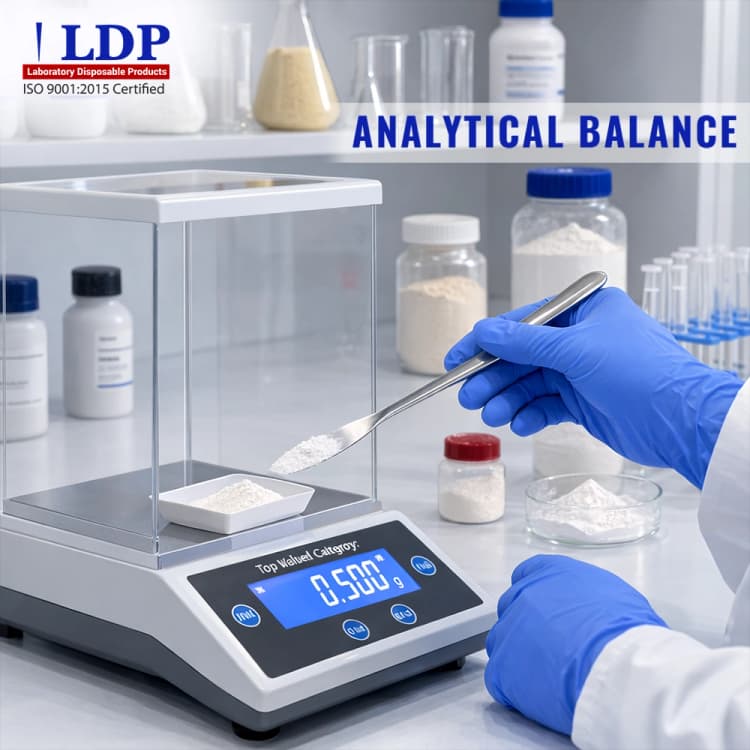
An Analytical Balance is an apparatus that is used to weigh minute masses with a very high degree of precision. This is a sensitive instrument that is more accurate and stable than the normal Laboratory Balance. Due to its accuracy, the Analytical Balance is also very common in research laboratories, universities, pharmaceutical firms and quality control laboratories.
This article describes the concept of an Analytical Balance, its operation, its typical uses in the laboratory and why calibration is required to ensure accuracy.
What is an Analytical Balance?
An Analytical Balance is a fine Laboratory Balance that is utilized to determine small amounts of materials with extreme accuracy. The majority of analytical models have a readability of 0.1mg (0.0001 g) enabling a scientist to identify very minute differences in weight.
An Analytical Balance is an enclosure that typically, in contrast to a basic Laboratory Balance, has a protective glass chamber known as a draft shield. This enclosure prevents the weighing process against air currents, dust and vibrations that could affect measurements.
The Analytical Balance due to its high sensitivity is commonly categorised as a Scientific Balance applied in complex laboratory work and as an analytical procedure. It is also known by many laboratories as a precision Analytical Weighing Scale that is used in very controlled measurements.
How an analytical balance works
Knowledge of the functioning of an Analytical Balance can assist laboratory professionals on how to use the device and record correct outcomes.
The majority of the contemporary Analytical Balance systems use a technology under the name of Electromagnetic Force Restoration (EMFR). When a sample is put on the weighing pan of the Analytical Balance it picks up the downward force because of gravity.
The Scientific Balance then creates an emanation of the electromagnetic force that opposes the sample weight. The system will detect and record how much force it needs to replace equilibrium and translate this force into a digital output.
Due to the high level of precision of this process, the Analytical Balance is regarded as one of the most accurate types of the Laboratory Balance equipment that can be found. The Contemporary Analytical Weighing Scale models have also incorporated the vibration protection, and digital stabilization features to enhance the reliability of the measurement.
Principal Characteristics of an Analytical Balance.
An Analytical Balance of high quality has some features that verify repeatable measurements and allow one to rely on the quality of their measurements.
High Readability
The Analytical balance instruments have a readability of 0.0001 grams thus are suitable for accurate lab test.
Weighing Capacity
The Analytical Weighing Scale available is either the average of 100 g to 500 g depending on the model used and the requirements of the laboratory.
Repeatability
The Repeatability in the Scientific Balance means that the results of the same sample are the same each time it is measured.
Digital Interface
The Laboratory Balance systems that are available in the contemporary world incorporate user friendly controls and easy to read displays that make laboratory functions easier.
The characteristics of the Analytical Balance make it a required Scientific Balance in the laboratories that need to have a competent and very accurate result.
Applications of Analytical Balance in Laboratories.
The Analytical Balance is also popular in various industries where accuracy in measurements is of great importance.
Chemical Laboratories
When preparing chemical solutions and reagents used in the laboratory, chemists use the Analytical Balance to weigh compounds with precision.
Pharmaceutical Industry
The Analytical Balance is applied in pharmaceutical research to determine active pharmaceutical ingredients with utmost precision. An Analytical Weighing Scale is an accurate instrument that will be used to make sure that the compounds are in appropriate proportions.
Research and Academic Laboratories.
An Analytical Balance is commonly used by universities as a teaching instrument in students' learning methods of laboratory measurements. This Scientific Balance enables the students to make correct experiments.
Laboratories of Environmental Testing.
An Analytical Balance is a kind of Laboratory Balance used by environmental scientists to weigh their pollutants, soil residues, and trace substances.
The Analytical Balance is one of the most dependable forms of Analytical Weighing Scale that is used in scientific laboratories due to its precision.
Significance of Analytical Balance Calibration.
To ensure the accuracy of an Analytical Balance, calibration is needed. The most sophisticated Scientific Balance can undergo changes in measurement with the environment, frequent use or even moving it.
Calibration on a regular basis provides the Analytical Balance with the ability to remain consistent even after it has been used. To ensure the accuracy of the Laboratory Balance system many laboratories have strict calibration procedures.
At Which Point is it Necessary to do the Calibration?
Calibration is to be done under the following conditions:
Before critical laboratory measures.
Then, when the Analytical Balance is transferred elsewhere.
Upon the change in temperature or humidity conditions.
During regular quality control.
Some of the more modern Analytical Weighing Scale models have internal calibration which aids in keeping such scales consistent in their precision.
Conclusion
One of the most important tools that is used in the modern laboratories is the Analytical Balance. Its use in the determination of very small masses with a high degree of accuracy makes it an important Scientific Balance in research, pharmaceutical development and chemical analysis.
The Analytical Balance is more sensitive and stable than a normal Laboratory Balance. Laboratories may be able to rely on an accurate and consistent measurement by a dependable Analytical Weighing Scale and ensure calibration is properly observed.
An Analytical Balance of high quality will assist the laboratories to be more efficient, to preserve the quality of research, and to obtain reliable scientific findings.
Frequently asked questions (FAQs)
Very small amounts of substances, particularly those found in laboratories, pharmaceutical research and chemical analysis, are measured with high precision using an Analytical Balance.
An average Analytical Balance has a 0.1 mg (0.0001 g) readability hence it is among the most accurate instruments of Scientific Balance.
The draft shield ensures that the Analytical Balance is not exposed to airflow, dust or other environmental disturbances that may undermine the accuracy of measurements.
Analytical Balance should be periodically calibrated, particularly prior to significant laboratory work.
Yes. An Analytical Weighing Scale is used to measure liquids, weighing them in a container and selecting the tare option to subtract the weight of the container.
Disclaimer: All the information on this blog is published in good faith and for general information purposes only. The information contained in this blog might be provided on an “as is” based on Wikipedia, Google, and other scientific articles. We are not liable for any injuries or damages for the use of the information. Please do your research before you use this information for any purpose.