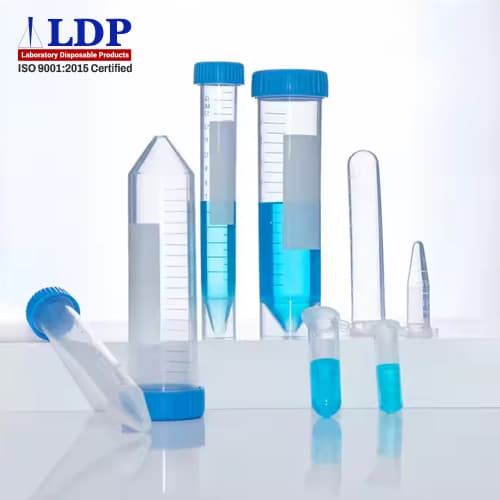
Choosing the Right Tubes: Types, Uses, Benefits, and More
On Saturday, 16 May 2026
In terms of operating a successful and effective laboratory, the appropriate tools and equipment are crucial. Perhaps one of the most basic yet underutilized pieces of labware is the laboratory tube. If you work in a clinical, research, pharmaceutical, or academic environment, laboratory tubes are a mainstay of daily operations. From containing chemical reactions to sample storage, proper laboratory tubes can play a huge role in the accuracy, efficiency, and safety of your lab.
Here in this blog, we will take you through everything you must know about laboratory tubes, ranging from the various types of laboratory tubes, their applications, materials, advantages, and how to select the optimum one for your lab.
What Are Laboratory Tubes?
Laboratory tubes are circular tubes commonly used to hold, mix, warm, and analyze chemical and biological samples. Laboratory tubes exist in various materials, sizes, and shapes depending on the intended use for which they are to be utilized. Whatever material they are made of, whether glass or plastic, laboratory tubes are an essential part of any laboratory setup.
Types of Laboratory Tubes
There are many types of laboratory tubes, and all serve a particular purpose. It is good to know the differences so that you can seek out the right product for your use.

Test Tube
These are the most commonly used lab tubes, used for stirring, heating, and observing reactions. They come in glass lab tube and plastic lab tube versions and are used in chemistry and biology labs.

Centrifuge Tubes
These laboratory tubes are designed to resist spinning at high speeds within centrifuges. They are usually provided with conical bottoms and caps that closely fit for sample safety.

Culture Tubes
Cell biology, as well as microbiology, laboratories utilize culture tubes. They are specifically suitable for growing microorganisms or holding culture media.

Microcentrifuge Tubes
Also known as Eppendorf tubes, they are small laboratory tubes used for handling extremely minute quantities (usually 0.5 mL to 2 mL).

Sample Storage Tubes
These are employed for the preservation of liquid or solid samples in the long term. Some of them are cryogenically rated for ultra-low temperatures.
Glass Laboratory Tube vs. Plastic Laboratory Tube
One of the earliest choices when choosing laboratory tubes is between glass and plastic. Both have their pros and cons:

Plastic Laboratory Tube
- Typically constructed of polypropylene (PP), polyethylene (PE), or polystyrene (PS)
- Lightweight, inexpensive
- Breakage-resistant
- Often supplied in sterile forms
- Applicable for one-time use

GlassLaboratory Tube
- Constructed of borosilicate or soda-lime glass
- High thermal shock resistance
- Suitable for high-temperature use
- Chemically inert
- Re-usable (following sterilization)
The use of a glass lab tube or a plastic lab tube is based on your laboratory’s individual requirements, such as cost, durability, temperature, and contamination level.
Lab Tubes and Their Applications
Advantages of Selecting the Appropriate Laboratory Tubes
1. Enhanced Precision: The appropriate tube reduces contamination and measuring errors.
2. Cost-Effectiveness: Choosing between reusable or disposable tubes based on the use can save money.
3. Improved Safety: Appropriate choice of material saves against breakage and chemical risks.
4. Operational Effectiveness: Laboratory tube selection based on the right laboratory tube for particular instruments (such as centrifuges) avoids disruptions to workflow.
How to Select the Best Laboratory Tubes
- Material: Choose between a glass lab tube or a plastic lab tube based on temperature and chemical compatibility.
- Capacity: Select the tubes of the right capacity for your experiment (from microliters up to several milliliters).
- Sterility: For clinical or microbiological applications, sterile lab tubes are required.
- Shape and Design: Flat bottom, round bottom, and conical bottom all have specific benefits based on application.
- Type of Cap: Screw caps, snap caps, or no caps select based on sample sensitivity and frequency of handling.
Where to Buy Quality Laboratory Tubes
At LDP (Laboratory Disposable Products), we provide an assortment of laboratory tubes from well-established brands and worldwide suppliers. Be it glass laboratory tubes for use at high temperatures or plastic laboratory tubes for one-time efficiency, we offer a solution that suits your lab.
Discover our range of laboratory tube types, all competitively priced and offered for bulk order. We also have expert assistance to assist you in selecting the correct laboratory tubes according to your specific needs.
Conclusion
Selecting the appropriate laboratory tubes is not about ease; it’s about accuracy, safety, and efficiency in your laboratory operations. By knowing the types of laboratory tubes, what they are used for, their advantages, and materials, you can make the best decision that will benefit your lab’s productivity.
Whether you need a glass laboratory tube for heating or a plastic laboratory tube for storing samples, LDP can provide. Browse through our range today and purchase laboratory tubes that are exactly to your specifications.