In any modern laboratory, efficiency determines productivity, whereas
accuracy determines reliability. Sustaining pharmaceutical research as
well as undertaking chemical analysis requires accurately configured
weighing equipment. In every laboratory, there exists the
analytical balance, which is one of the most accurate pieces of equipment in the weighing
balance category. It is used for measuring small masses. An accurate
balance is crucial for an academic lab, pharmaceutical facility, or an
industrial research and development center.
This comprehensive guide covers what an
analytical balance
is used for, how an
analytical balance
works, how to calibrate it, and important features to consider before
purchasing. If you’re searching to buy
analytical balances
online,
LDP
(Laboratory Disposable Products) offers a wide range of reliable
options.
What is an Analytical Balance?
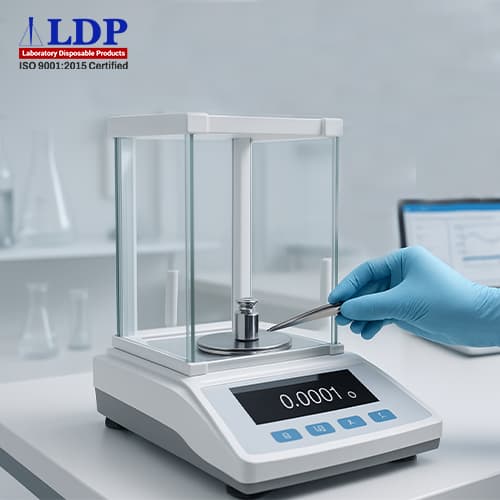
This type of laboratory balance is used to measure small sample masses
with exceptional accuracy.
analytical balances
are used in research labs, educational institutions, and pharmaceutical
environments.
With scientific balances, users can attune to minute sample mass
differences with readability to 0.0001 g (0.1 mg). For processes—such as
reagent preparation, drug formulation, or quality control
testing—requiring extreme sensitivity, an
analytical balance
is indispensable as it helps avoid even microgram discrepancies.
How does an analytical balance work?
The electromagnetic force restoration mechanism of the balance
counteracts a force induced by the sample’s mass, so the sample achieves
a digital readout. To provide stable measurements and protect the
mechanism from air drafts, most analytical weighing scales are equipped
with a draft shield. Understanding how an
analytical balance
works is critical with respect to refining balance optimization and
performance across multiple scientific disciplines.
The sensitivity and accuracy of analytical balances
Each
analytical balance’s
defining quality is the accuracy for precision weighing of small
quantities that these instruments guarantee with reproducibility.
Key specifications:
- Recall: Generally, 0.1 mg (0.0001 g)
- Capacity: 100 to 500 grams
-
Repeatability: Measurement consistency over multiple
attempts
Each of these features allows the balance to be useful in the sensitive
weighing tasks in sample prep, titration, and chemical tests.
Analytical Balances Uses and Applications
Now, what is an
analytical balance
used for? The provided quotations demonstrate distinct sectors:
Chemical Labs
Accuracy is mandatory in the blending and formulating of chemical
compounds.
Pharmaceutical Labs
Measurement and monitoring of Active Pharmaceutical Ingredients
(APIs) is conducted with precision.
Universities
For evaluation and application purposes in academic exercises, the
evaluation and application of modern balancing techniques are
designated by the instructor.
Environmental Assessments
Accurate measurement of pollution and appraisal of residual samples.
In all professional and academic scenarios that require granular
precision measurement, detailed, precise measurement balances are
pivotal.
How to Calibrate an Analytical Balance
For accuracy, calibrations must be done regularly. Balances are
calibrated using different methods and techniques. How frequently should
I calibrate my laboratory balance?
For best accuracy in laboratory balance measurement, the following
guidelines should be observed:
-
Require special measurement accuracy, precision checks, and
calibrations.
- Before every measurement that is deemed important.
- After the device is moved to a different location.
-
After any changes to the environment, for example, relative humidity
and room temperature.
Most modern scientific balances come with internal and external
calibrations.
Internal Calibrations
Automated with built-in calibrated weights providing for internal
accuracy.
External Calibrations
Done manually using calibrated weights providing for external
accuracy.
Knowledge of balance calibration helps achieve compliance and stability
for the instrument.
Important Features to Consider While Choosing Analytical Balances
Due to the varying laboratory functions, different types of
analytical balances
are designed for different uses. Look for the following features:
Readability & Capacity – Measurement aligns with
the precision needed.
Calibration Type – External calibrations are less
convenient than internal.
Draft Shield – Of utmost importance for accuracy.
Taring Function – Useful for measuring several
different substances in one container.
Connectivity Options – For data transfer, USB or
RS232 ports are available.
Security and user interface – Clear display and
easy-to-use controls.
Compliance – Adheres to regulatory standards: ISO,
GLP/GMP, or USP.
These factors help maximize the performance and lifespan of your
analytical weighing scale.
Where to Buy Analytical Balances
Are you in need of an accurate
analytical balance
of laboratory grade?
LDP
(Laboratory Disposable Products) is an industry-renowned distributor
both for its most sought-after balance and scientific balance products
and their top-tier industry manufacturers.
Whether you need a basic precision weighing tool for educational
purposes or a high-end analytical weighing scale for pharmaceutical
research,
LDP
provides competitive prices, expert guidance, and reliable after-sales
support.
Conclusion
In precision-critical laboratory environments, the
analytical balance
is the cornerstone instrument.
Ensuring that your laboratory operational standards calibrate your
laboratory balance for reliability rests on understanding: what is an
analytical balance
used for, how does an
analytical balance
works, and how often should I calibrate my laboratory balance.
For trusted services, expert advice, and quality instruments,
LDP
is your resource for analytical weighing scales if you’re purchasing a
new one or upgrading your scientific balance.
Disclaimer: All the information on this blog is
published in good faith and for general information purposes only. The
information contained in this blog might be provided on an “as is”
based on Wikipedia, Google, and other scientific articles. We are not
liable for any injuries or damages for the use of the information.
Please do your research before you use this information for any
purpose.