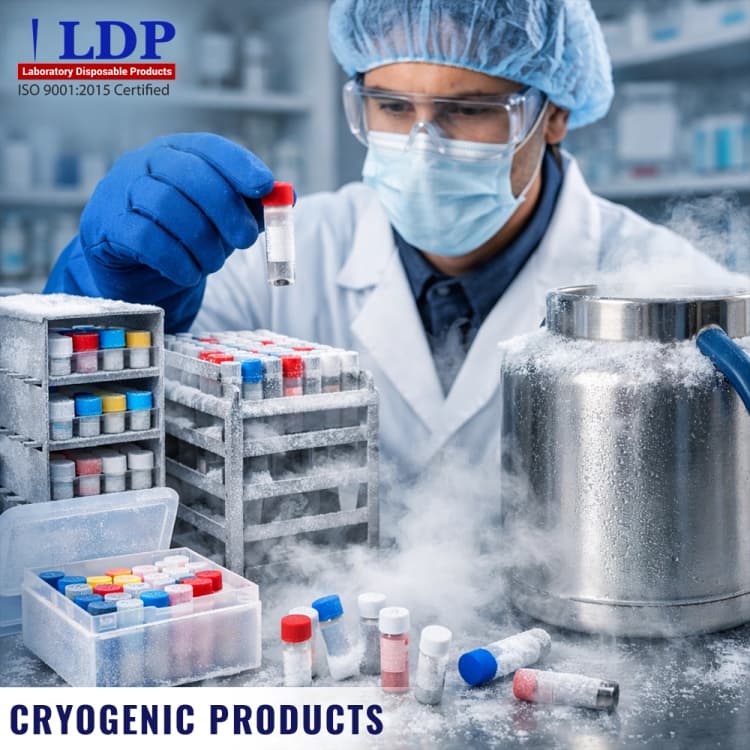
Cryogenic Products: Safe Storage and Transport Solutions for Modern Laboratories
On Monday, 23 March 2026
Cryogenic Products are a necessity in the modern scientific and industrial environment since they are used to store sensitive biological materials, chemicals, and those that are sensitive to temperature. In high-tech research laboratories, pharmaceutical production, and diagnostics laboratory, appropriate Cryogenic storage will provide stability in samples, regulatory standards, and data accuracy. In the absence of dependable Cryogenic lab equipment, even small variations in temperature can destroy years of work.
In Laboratory Disposable Products (LDP), we offer the full range of Laboratory cryogenic supplies that are designed for performance, durability, and safety. This blog discusses the definition of Cryogenic Products and uses of cryogenic supplies in the labs, safety and handling of cryogenic materials in the lab, and the locations where one can purchase cryogenic products that are professionally acceptable.
What Are Cryogenic Products?
Cryogenic Products are designed containers and handling systems to contain and transport materials under very low temperatures. Liquid nitrogen is used in many applications, which means it necessitates equipment that has been specifically designed to endure thermal stress and material failure.
The cryogenic storage is popular in:
Laboratory tests in biopharmaceuticals.
Scholarly research organizations.
Clinical and diagnostic facilities.
Biotechnology companies
Cold-chain logistics in industries.
What Are Cryogenic Supplies Used for in Labs?
Cryogenic supplies are required in:
Stem cell and cell culture preservation in the long term.
Storage of enzymes, plasma, DNA, and RNA.
Tissue and reproductive samples cryopreservation.
Storage and transportation of vaccines.
Safe transportation of perishable goods.
Laboratories risk losing laboratory samples, contamination, and experimental reproducibility in the absence of high-quality Cryogenic Products. Quite accurate cryogenic laboratory equipment secures investments in research.
Significant Groups of Cryogenic Products.
Knowledge of the major categories of Laboratory cryogenic suppliers assists the laboratories in selecting the appropriate type of storage system.
1. Cryogenic Vials and Tubes
Any Cryogenic storage system has cryogenic vials and tubes, which are also essential. These are special containers that can withstand the lowest level of temperatures without cracking or leaking.
Key features include:
- Polypropylene construction.
- Internal or external threaded caps.
- Leak-proof O-rings of silicone.
- Resistance to low temperatures down to -196 °C.
- Volumes between 1 mL and 5 mL are available.
Blood samples, microbial cultures, nucleic acids, and biologics are best stored in cryogenic vials and tubes. The freezers and liquid nitrogen tanks are enhanced with proper labeling and color-coded caps that enhance traceability. Our Cryogenic Product in LDP is designed to provide the safety of storage and compatibility with the regular rack systems.
2. Dewar Flasks and Liquid Nitrogen Containers.
A dewar flask is a vacuum-insulated container that is capable of holding cryogenic liquids, e.g., liquid nitrogen. These are important parts of professional Cryogenic lab equipment.
Dewar flasks:
- Keep ultra-low temperatures constant.
- Reduce evaporation loss
- Help with the transfer of samples safely.
- Come in portable and stationary models.
Ventilation is required to avoid the effect of pressure build-up. These Cryogenic Products are safe and efficient in the handling of cryogenic fluids when they are properly used.
3. Cryogenic Storage Racks
Cryogenic storage racks are structural systems that are employed in the arrangement of cryogenic vials and tubes in freezers or tanks of liquid nitrogen. These racks are made with stainless steel or aluminum that is resistant to damage by corrosion, maximizing the storage space and enhancing inventory control.
Benefits include:
- Maximum space utilization
- Simply indexing and tracking of samples.
- Reduced handling risks
- Cryo-box systems compatibility.
Racks are an element of total Laboratory cryogenic supplies, which promotes the safety and laboratory workflow efficiency.
4. Cryo-Storage Boxes
Cryo-storing containers allow storing vials in position and an organized manner at ultra-low temperatures. Such boxes can be made of fiberboard, polycarbonate, and waterproof materials.
They:
- Prevent vial displacement
- Enhance the visibility of labels.
- Ensure vapor phase storage structural integrity.
- Support systematic freezer organization.
The use of cryo-boxes is essential in well-organized Cryogenic storage programs, particularly in biobanking and research institutions with large collections of samples.
How to Handle Cryogenic Materials Safely in the Lab
The use of Cryogenic Products is associated with the risk of cold burns and frostbite, displacement of oxygen, and rupture of containers, which can only be avoided by following strict safety measures.
The fundamental Safety Principles:
Wear Proper PPE
Wear insulated cryogenic gloves, face masks, lab coats, and closed shoes.
Make sure it is well-ventilated.
Oxygen can be replaced by evaporating cryogenic liquids. Always work in open places.
Avoid Direct Contact
Always put on protective gloves when handling cryogenic liquids or metals.
Monitor Pressure Levels
Dewar flasks should have the ability to be vented. Sealed systems may prove risky.
Work with Certified Cryogenic Lab Equipment.
Equipment that has been rated to withstand extremely low temperatures only should be used to avoid structural failure.
These practices ensure the safety of the staff, as well as, safeguarding the quality of samples.
Where to buy Cryogenic products.
When you are looking at where to buy cryogenic products, you should make sure that you select a supplier that will give importance to quality, compliance, and reliability.
Laboratory Disposable Products (LDP) offers quality Cryogenic Products and Laboratory cryogenic supplies, which include:
Our commitment includes:
- Fair and open pricing.
- Bulk purchasing options
- Fast and secure shipping
- Established relationships with manufacturers.
The decision to choose LDP provides an opportunity to access high quality Cryogenic storage solutions to the laboratory standard.
Final Thoughts
Cryogenic Products are high-performance products that are required by the laboratory and industry that require preservation at ultra-low temperatures. Whether it is cryogenic vials and tubes or the state-of-the-art Cryogenic lab equipment, the correct Laboratory cryogenic supplies are the way to preserve the integrity of samples, increase research efficiency, and achieve long-term research success.
Knowledge on the use of cryogenic supplies in laboratories, safety in handling cryogenic materials in the laboratory, and the purchase of cryogenic products can aid in the decision-making process of the laboratories. The investment in the trusted Cryogenic storage solutions does not only concern the equipment, but also the science and the reliability of the outcomes.
Frequently asked questions (FAQs)
Cryogenic supplies are applied in the storage and transportation of biological samples, chemicals, vaccines, and sensitive research materials at very low temperatures.
They are specially made containers that are designed to store samples safely in deep-frozen and liquid nitrogen conditions.
Wear protective equipment, keep the space ventilated, use certified equipment, avoid direct contact with cold surfaces, and examine the pressure of containers.
Laboratory Disposable Products (LDP) is a reputable supplier of laboratory consumables, other storage solutions, and cryogenic products.
The most widespread ones are cryogenic vials, Dewar flasks, cryogenic storage racks, cryo-boxes, and personal protective equipment.
Disclaimer: All the information on this blog is published in good faith and for general information purposes only. The information contained in this blog might be provided on an “as is” based on Wikipedia, Google, and other scientific articles. We are not liable for any injuries or damages for the use of the information. Please do your research before you use this information for any purpose.