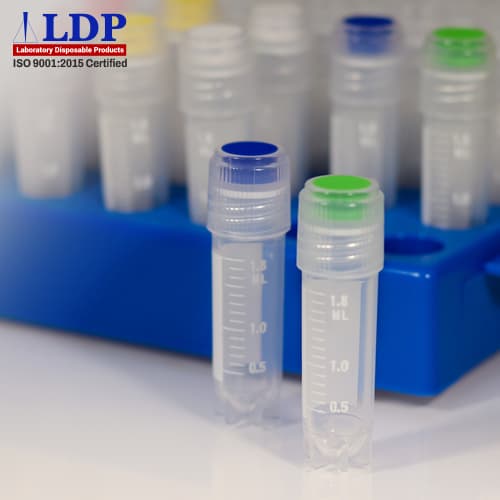
Select the Right Cryogenic Storage Vial for Your Laboratory
On Monday, 12 January 2026
Selecting the right cryogenic storage vial is important to ensure the integrity and shelf life of your samples in any laboratory environment. From cutting-edge research to clinical laboratory management or long-term storage of samples in a biobank, reliable cryogenic storage vials are essential. Vials are formulated to ensure sample integrity at ultra-low temperatures, often as low as -196°C.
This blog will assist you in choosing the optimal cryogenic storage vial considering major factors such as vial type, vial material, and compatibility with samples. We’ll also explore how these vials impact lab sample preservation and storage efficiency.
Why Cryogenic Storage Vials Are Crucial
A cryogenic storage vial is more than a laboratory vial. The specialized laboratory vials are designed to withstand extreme cold, avoid leakage, and keep biological and chemical contents stable over the long term. Standard plastic tubes become brittle and can shatter when exposed to cryogenic temperatures, potentially contaminating or destroying the sample.
Accurate sample storage relies on high-quality cryogenic vials that adhere to laboratory standards. The inappropriate vial can invalidate research, waste resources, and cause critical testing or discovery delays.
Types of Cryogenic Storage Vials
Understanding the two general types of cryogenic storage vials helps you make an informed purchasing decision:
1. Internal Thread Vials
Internal thread vials trap the cap screw in the vial wall with a tamper-evident, secure seal. These are perfect for dense storage systems and laboratories where contamination control is important.
Advantages:- Airtight storage in a secure seal
- Automated system compatible
- Excellent for long-term lab sample storage
2. External Thread Vials
External thread vials contain threads on the exterior of the vial, which make them convenient to handle and label. They offer slightly more internal volume, which comes in handy when sample size or packing isn’t a concern.
Advantages:- A slight additional space for labeling
- More usable sample volume
- Perfect for hand sample storage protocols
Key Things to Keep in Mind When Choosing a Cryogenic Storage Vial
To ensure the long-term integrity and safety of your stored samples, take the following into consideration:
Vial Material
The material of the vial contributes significantly to the effectiveness of the cryogenic storage vial at ultra-low temperatures. The gold standard is medical-grade polypropylene because it is resistant to chemical degradation, warping, and cracking.
Consider:
- High-purity medical-grade plastics
- Low protein and nucleic acid binding
- Mechanically and solvent-resistant
Capacity
Cryogenic storage vials can be found in various sizes, i.e., 0.5 mL to 5 mL. The appropriate size will rely on the type of sample and the required volume in your laboratory.
Sterility and Certification
For labs handling delicate biological material, sterile cryogenic vials are necessary. Choose products that are gamma-irradiated and RNase, DNase, and pyrogen-free.
Labeling and Identification
Low-temperature sample storage requires clear identification. Most vials provide barcoded labels, writable space, and color-coded lids for easier labeling and storage organization and retrieval of samples from cold storage compartments.
Cap Seal and Closure
Certain laboratory vials have silicone O-rings or self-sealing screw caps to ensure a tight, leak-free closure. Always ensure the vials are compatible with vapor-phase or liquid-phase liquid nitrogen storage to avoid sample explosion or leakage.
Use Case: Selecting by Laboratory Type
Labs require different lab types of cryogenic storage vials. Here's the way to choose well:
1. Research Laboratories:
Use barcoded internal thread vials in the tracking of bulk quantities of samples in automated platforms.
2. Clinical Laboratories
Sterile external thread vials are perfect for storing blood, plasma, or DNA samples in high-traffic laboratories.
3. Biobanks
For long-term laboratory sample storage, choose certified cryogenic vials with secure O-ring seals that support liquid nitrogen vapor storage.
Common Mistakes to Avoid
Steer clear of these expensive mistakes when choosing cryogenic storage vials :
- Using lab vials not designed for ultra-cold temperatures
- Forgotten compatibility with liquid nitrogen storage techniques
- Forgotten consideration for certified, sterile vial material
- Selecting vials that lack proper labeling features for traceability of samples
Final Thoughts
The success of your lab depends on the smallest detail, and one of the most crucial ones is selecting the correct cryogenic storage vial . By opting for vials constructed from high-quality vial material, with an appropriate cap type and capacity, you can store samples safely and efficiently in all applications.
At LDP , we provide a variety of cryogenic storage vials , such as internal thread vials and external thread vials designed for each scientific use. Our vials enable safe, sterile, and durable lab sample preservation in even the most challenging settings.
Discover our entire line of cryogenic storage vials today to keep your precious samples safe and enable your lab’s mission.