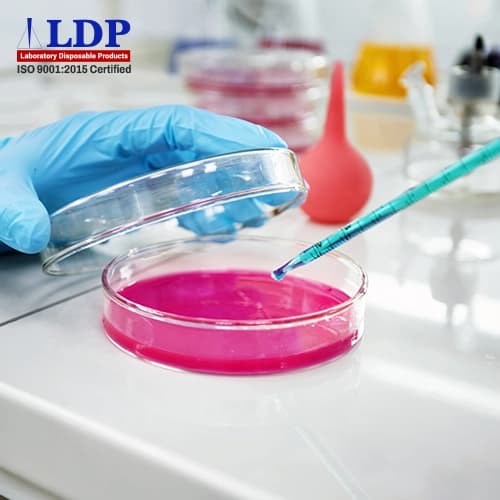
Types of Petri Dishes and Their Applications in Modern Laboratories
On Monday, 12 January 2026
The inclusion of petri dishes in the modern laboratory setting has become a standard of contemporary laboratories, offering a platform of essential microbial growth and research and education. The knowledge of Petri dishes types and applications is important to any laboratory professional, student or researcher. These diverse dishes enable the scientists to grow microorganisms, understand the growth of bacterial and fungal cells, carry out antibiotics tests and carry out environmental surveys.
In this blog, we will discuss about what is a petri dish , types of petri dishes , applications of petri dishes , How to Choose the Right Petri Dish , and where to buy Petri dishes online in the USA.
What Is a Petri Dish?
A Petri dish is a round and shallow container, usually of glass or plastic, used as a controlled system to grow microorganisms. Through a combination of petri dishes and nutrient agar or other growth medium, scientists will be able to view microbial colonies, carry out experiments, and gain a better understanding of the results.
Examples of microbiological uses of petri dishes are isolation of bacteria, environmental surveillance, testing of antibiotic susceptibility and educating microbiology concepts in schools and colleges. They are essential in the contemporary laboratories as research, diagnostics, and educational resources.
Types of Petri Dishes
In the contemporary laboratories, various Petri dishes are used which have different attributes based on the nature of the experiment. The knowledge of the kind and application of Petri dishes can guarantee the best outcome in the field of microbiology and research experiments.
1. Glass Petri Dishes
Glass Petri dishes are comprised of heat-resistant borosilicate glass, and thus, can be sterilized repeatedly and used over a prolonged period of time.
Key Features:
- Heat-resistant and reusable
- Have surface visible to easily observe cultures.
- Autoclavable or dry heat sterilizable.
Applications:
- Quantitative microbiology research
- Water and environmental testing
- Educational laboratories
- Sustainable and cost-conscious labs
2. Plastic Petri Dishes
Plastic Petri dishes are usually made of polystyrene and are usually pre-sterilized to be used once only.
Key Features:
- Disposable and pre-sterilized
- Lightweight and cost-effective
- Clear surface for microbial observation
Applications:
- Classroom microbiology
- Pathogen and antibiotic testing
- Food and pharmaceutical microbiology
- Large-scale microbial studies
3. Compartmentalized or Divided Petri Dishes
Split Petri dishes consist of more than two compartments allowing multiple cultures in a single dish.
Applications:
- Comparative microbial experiments
- Multiple strain testing
- Educational demonstrations
4. Vented and Non-vented Petri Dishes
Vented Petri dishes ensure moisture control and aerobic growth.
Non-vented dishes are airtight for anaerobic or moisture-sensitive experiments.
Applications:
- Vented: aerobic bacterial growth
- Non-vented: anaerobic or moisture-sensitive studies
5. Square and Specialty Dishes Petri.
Square or specialty dishes are developed to perform experiments of high throughput or automated laboratory instrumentation. They are perfect in the high-level research due to their bigger surface area and compatibility with the imaging systems.
Applications:
- Microbial screening on a high throughput.
- Plant tissue culture research.
- Colony and imaging analysis that is automated.
- Experiments which need large culture areas.
Applications of Petri Dish in Microbiology
The applications of Petri dishes in microbiology are many, in fact vital to the advancement of science:
Growth of bacterial cultures: The cultivation and isolation of bacterial cultures to be observed.
Fungal Studies: The study of fungal morphology, growth and behavior.
Antibiotic Sensitivity Testing: The application of antibiotics on microbes.
Environmental Monitoring: The examination of air, soil and water samples regarding their microbial contamination.
Eukaryote Cell Culture Research: Nourishing proliferation of eukaryotic cells to high-level research.
Educational Demonstrations: Sometimes it is possible to provide the students with the hands-on experiments in the classrooms.
Quality Control in Industry: This is applied in food, pharmaceutical and cosmetic industries, to guarantee microbial safety.
How to Choose the Right Petri Dish
The selection of appropriate Petri dish is based on:
| Requirement | Recommended Type |
|---|---|
| Long-term, reusable use | Glass Petri dish |
| Single use, disposable | Plastic Petri dish |
| Aerobic growth of bacteria | Vented Petri dish |
| Anaerobic growth | Non-vented Petri dish |
| Separate samples at a time | Separated Petri dish |
Where to Buy Petri Dishes in the USA
LDP is a good supplier of Petri dishes in the USA, and in case you need to purchase them online, you can choose:
- Glass and plastic Petri dishes of the high quality.
- Disposable and reusable options of all laboratory requirements.
- Low prices and option of bulk purchase.
- Laboratory products of sterility and ISO certification.
Buy affordable Petri dishes online USA from LDP today and equip your lab with reliable, high-quality dishes for microbiology research, educational labs, and industrial testing.
Frequently Asked Questions (FAQs).
The most prevalent are glass and plastic. Glass is recyclable and strong whereas plastic is disposable and pre-sterilized.
Single-use plastic dishes are not to be reused in order to prevent contamination.
Glass Petri dishes are sterilized through autoclaving and plastic dishes are already sterilized and can be used.
The conventional diameter is 90 mm, but there are also 60 mm and 150 mm dishes that have their application.
LDP is a reputable online manufacturer of glass and plastic Petri dishes and sells quality and low-priced labware.
Conclusion
The categories and applications of Petri dishes are fundamental to the knowledge of a person in the field of microbiology, research or even in teaching laboratories. Glass Petri dishes to use in reusable and long-term experiments to plastic Petri dishes to use in convenient and simple straightforward experiments, making the correct choice of Petri dish is helpful in increasing the accuracy and efficiency of the experiment.
LDP has a variety of high quality, sterile, and affordable Petri dishes , which are available in classrooms, research laboratories, and industry which can be purchased online in the USA. Prepare your lab with the appropriate Petri dishes today and get good and reliable results without any contamination.
Disclaimer: All the information on this blog is published in good faith and for general information purposes only. The information contained in this blog might be provided on an “as is” based on Wikipedia, Google, and other scientific articles. We are not liable for any injuries or damages for the use of the information. Please do your research before you use this information for any purpose.