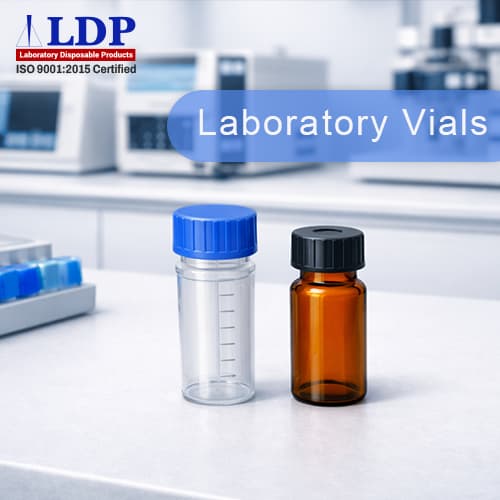
Understanding Laboratory Vials-Types, Materials, and Applications in High-Throughput Analytical Laboratories
On Monday, 09 February 2026
Laboratory vials are essential parts of the analytical, pharmaceutical and research laboratories. They have applications in the collection, storage, transportation, and analysis of samples in a broad variety of scientific applications. In the contemporary laboratory - particularly the ones dealing with large volumes of samples - then proper choice of laboratory vials is essential towards preserving the integrity of the samples, ensuring the accuracy of analysis and supporting efficient work processes.
This general guide discusses the kinds of the types of laboratory vials used in analytical laboratories, the materials and closure systems available, and how these vials support high-throughput and regulated laboratory environments. It also provides practical guidance on how to choose the right laboratory vial for specific applications and where to source reliable vial consumables in the USA.
The Importance of Laboratory Vials in Modern Laboratories.
In analytical laboratories, the most common point of contact between the sample and the analytical instrument is laboratory vials . Vials should require samples to be safeguarded against contamination, evaporation, and chemical reaction, whether in chromatography, sample preparation, or storage.
As more and more automation and precise instrumentation are being sought, it has led to laboratories relying on laboratory vials for high-throughput analysis with consistent dimensions, chemical compatibility and safe sealing. A bad or inappropriate choice of vials may result in losing samples, erratic results and expensive re-work, so vial selection is one of the most important decisions in any laboratory process.
Types of Laboratory Vials in Analytical Laboratories.
The types of vials that may be used to address the needs of the analytical and research settings are numerous. Knowing their distinctions assists the laboratories in choosing the most suitable alternative to their uses.
Sample Vials
Sample vials are common laboratory vials that are used to store samples, store reagents and prepare samples before analysis. They come in several volumes and configurations and thus are applicable in a wide variety of tasks in the laboratory.
Sample vials are usually utilized in:
- Analytical and quality control laboratories.
- Chemical and reagent storage.
- Sample preparation procedures.
These are glass and plastic vials to suit the various chemical and handling procedures.
Autosampler Vials
The autosampler vials are manufactured to precision to make them compatible with automated analytical tools. They can be fitted into autosamplers, with a high degree of accuracy, to inject samples and provide reproducible analytical data.
Autosampler vials find a wide range of applications in:
- Pharmaceutical quality control.
- Laboratories of environmental tests.
- Laboratories- High throughput analytical.
The uniform size and consistency of their sealing are necessary because they are needed for labs with many samples per day.
Cryo Vials
Cryo vials are meant to be stored under ultra-low temperature; freezer storage and liquid nitrogen. The vials are designed to withstand high temperature and extreme temperature changes as well as freezing and thawing.
The cryo vials are generally utilized in:
- ➤ Biobanking and clinical research.
- ➤ Cell culture and molecular biology.
- ➤ Long-term storage of biological samples.
Quality cryo vials have screw caps that are leakproof and strong to ensure that the sample is not lost in the process of cryogenic storage.
Micro and Specialty Vials
Micro vials are utilized in instances where the sample volumes are very small or there is a need to carry out a high level of analytical sensitivity. These vials are used in conjunction with inserts to optimize the recovery of samples and reduce dead volume.
Applications include:
- ➤ Trace analysis
- ➤ Proteomics and metabolomics.
- ➤ Limited or high-value sample research.
Laboratory Vials: Materials.
The type of material which is used in constructing the laboratory vials is critical in its performance and suitability.
Glass Vials
Glass or, more specifically, borosilicate glass vials are very popular in the analytical laboratory as they exhibit great chemical resistance and minimal extractables. They can also be used with the majority of organic solvents and harsh reagents.
The advantages of glass vials are:
- ✔ High chemical inertness
- ✔ Excellent optical clarity
- ✔ Minute contact with analytes.
The amber glass vials are usually used when dealing with photosensitive samples.
Plastic Vials
The plastic vials are normally made of polypropylene or polyethylene. The vials are easy to carry, have a shatter-resistant property, and can be easily used in a lab and biological practice.
Since plastic vials are preferred in:
- ✔ Sample transport
- ✔ Cryogenic storage
- ✔ Applications that need impact resistance.
A great number of plastic laboratory vials are autoclavable and can be used with biological samples.
Vial Closure Systems and the Significance.
Closure systems are essential in preventing the leakage, evaporation and contamination.
Screw cap vials have secure resealable closures and are commonly used in storage and analysis. Crimp top vials are tightly sealed with no tamper evidence and are best used with volatile samples. Snap cap vials can be sealed and opened quickly to facilitate high throughput workflow.
The choice of the closure guarantees the integrity of the samples during the analysis.
Selecting the Appropriate Laboratory Vial.
Knowing how to choose the right laboratory vial requires careful consideration of several factors:
- Technique of analysis (HPLC, GC, LC MS)
- Sample volume and sensitivity
- Chemical compatibility
- Storing temperature requirements.
- Instrument and autosampler compatibility
The correct choice of the vials will help to overcome the risk of contamination and enhance the reproducibility as well as efficient lab functioning.
Applications of Laboratory Vials
The application of laboratory vials is wide-spread in many industries, such as:
- Pharmaceutical research and quality management.
- Biotechnology and life sciences.
- Clinical diagnostics
- Environmental testing
- Research in an academic and industrial setting.
In each sector, vials for pharmaceutical and analytical applications must meet strict quality and performance standards to ensure reliable results.
Where to Buy Laboratory Vials Online in the USA
The laboratories interested to buy laboratory vials online in the USA should select the suppliers who guarantee high quality, a wide range of products, and a reliable supply. Laboratory Disposable Products (LDP) offers an extensive range of laboratory vials , such as cryo vials, sample vials and other vials that are used in the fields of analytical, pharmaceutical, and research laboratories.
As LDP comes in many different sizes, materials, and configurations, it can be used to support both standard lab workflows and high-throughput analysis.
Conclusion
Analytical and high-throughput laboratory settings would not be complete without laboratory vials . Knowledge about the various kinds of laboratory vials , materials and closure mechanisms allow laboratories to streamline operations, preserve samples and get quality results of analysis.
Through proper choice of vial to be applied in a specific application and source of a reliable supplier of vials , the laboratories can be assured of standard performance in its pharmaceutical, analytical and research activities.
Frequently Asked Questions (FAQs)
In laboratory and pharmaceutical, biotechnology and research laboratories, samples are stored, transported, and analyzed in laboratory vials. They assist in the preservation of samples during preparation and testing.
The major ones are sample vials, autosampler vials, cryo vials, and micro vials among others. The types are each intended to be used in a certain analytical or storage application.
Glass vials have been used in most of the applications of analysis because of the inertness of the material and its solubility with the solvents. Biological samples, transportation and cryogenic storage are the common applications of plastic vials.
In the USA, the lab vials may be purchased online by the laboratories through trusted suppliers like Laboratory Disposable Products (LDP), which sells a variety of lab vials and consumables to the analytical and research laboratories.
Disclaimer: All the information on this blog is published in good faith and for general information purposes only. The information contained in this blog might be provided on an “as is” based on Wikipedia, Google, and other scientific articles. We are not liable for any injuries or damages for the use of the information. Please do your research before you use this information for any purpose.