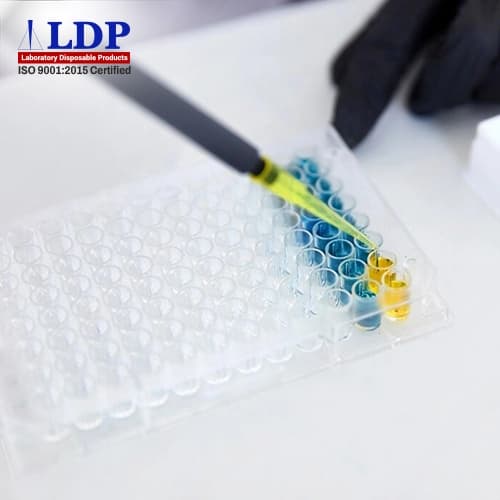
Why 96-Well Plates Are a Foundation of Efficient Cell-Based Research
On Monday, 30 March 2026
Cell research is a key component in biotechnology, biomedical research, and pharmaceutical development. Since the laboratories are becoming increasingly automated and therefore data-intensive in operations, the standard lab consumables are very necessary. Among them, 96-well plates and 96-well microplates have become significant tools of inexpensive, reproducible, and scalable experimentation.
Their fame is preconditioned on their ability to promote the optimization of the cell culture, high-throughput screening, and automated research environment across the U.S.-based laboratories.
Experience in 96-well plates and 96-well microplates.
A 96-well plate is a type of microplate that is manufactured in the form of 8 x 12 wells that are small in size. The wells are considered distinct cells to be utilised in cell culture, cell tests, or experimental setups. Due to the standard size, 96-well microplates are compatible with most of the lab instruments and automation systems.
Such a standard format allows the researchers to conduct many experiments simultaneously under the same conditions, which is a requisite for attaining credible scientific outcomes.
The 96-Well Plates are important to optimize Cell Culture.
The concept of optimization of cell culture by use of 96-well plates is premised on the notion that they can be utilized to offer controlled, repeatable and parallel clinical trials. The task that could be comprised of the experimentation of different variables, such as the nutrient concentration, growth factors, and treatment conditions, may be the optimization of cell culture. These parameters may be compared, and at the same environmental conditions, with 96-well plates .
This limits variability and improves the quality of the data, and the 96-well plates have become an unavoidable part of a modern cell culture procedure.
Improving cell culture using 96-Well Plates.
The manner in which 96-well plates are uniform in their design is the first means through which that plate effectively promotes cell culture. Each of the wells is of the same geometry and volume, and cell seeding is uniform and the exposure to media and treatments is balanced. This kind of consistency reduces the error in experimentation and enhances reproducibility.
Furthermore, the small working volumes in 96-well plates can be easily manipulated to give an experiment excellent fine-tuning of culture procedures and increased efficiency of the whole experimental procedure.
The benefits of 96-Well Plates in High-throughput Screening.
One of the best benefits of high-throughput screening using 96-well plates is that it can be applied to test a great number of samples or compounds simultaneously. High-throughput screening is also widely applied in pharmaceutical and biotechnology research to determine a great number of conditions within a short period of time.
Laboratories can conduct drug screening assays, toxicity studies, as well as dose-response analysis in an efficient way with 96-well microplates and be consistent across all the test conditions.
The Interchangeability of Automated Cell Cultures.
The current laboratory operations and 96-well plates are designed in such a manner that they can be used in automated cell culture procedures. The homogeneity of their footprint provides them with an opportunity to be able to operate with robotic liquid handlers, plate readers, incubators, and imaging systems.
This compatibility reduces handling of manual handling, increases the throughput, and allows large-scale cell-based assays, such that 96-well plates will become appropriate to everyday research studies, not to mention the state-of-the-art screening applications.
Cell Culture Microplates, 96 wells.
The microplates can be employed in a wide variety of research fields because of the flexibility of the 96-well microplates for cell culture applications. They can be used in adherent and suspension cell cultures based on their surface treatment and the design of wells.
Such microplates in the laboratory are usually used in:
Their block has the necessary flexibility when it comes to the exploratory research as well as the testing protocols.
Reduced Reagent Use and Productivity of the Workflow.
The cell culture microplates require less media and reagents than the culture vessels of the traditional type. This will save on the expenses involved in carrying out the experiment and promote sustainability in the lab.
Plates such as a 96-well format of cell culture can optimize the entire workflow and supply data of high quality, hence enabling a large number of experiments to be conducted in a single plate.
Its Applications to Research and Industry.
he common applications in the life science disciplines in 96-well plates include:
Pharmaceutical screening assays
Laboratories that conduct cell-based testing in Biotechnology.
Research in cell signaling and cell growth.
Industry laboratories that have automated cell culture techniques.
These are a good choice in the U.S. research laboratories because they have standard designs and are reliable in terms of performance.
Conclusion
Advanced cell-based research depends on the efficiency, greater accuracy, and scalability of the instruments: 96-well plates and 96-well microplates can be applied in modern laboratories and assist in optimization of cell cultures, high-throughput screening, and laboratories with automated capabilities.
The effect of the 96-well plates is evident in every research area since it has contributed to increasing the validity of experiments, to the extent of offering an effective strategy in the drug screening process. The utilization of laboratory technologies in the procedure of reproducible and trustworthy cell culture research will be at the center stage of science as the techniques continue to be enhanced.
FAQs
Cell-based assays, drug screening assays, and normal cell culture procedures require 96-well plates, which are needed when there are numerous experiments to be carried out simultaneously under controlled conditions.
The small-scale research design facilitates testing in parallel, and this allows researchers to test numerous variables at any given time. Therefore, the 96-well plates promote cell culture and overall experiment time.
With high-throughput screening, the benefits of 96-well plates are that they are faster to generate data, consume less reagent, and can utilize automated cell culture systems.
The cell culture microplates are applied in cell-based assays, microplate screening workflows in the laboratory, and drug screening assays in biotechnology and pharmaceutical research.
The significance of the 96-well plates in the optimization of cell culture is that, when the 96-well plates are used, a homogenous culture can be supplied, hence optimization of the cell growth parameters can be done in a consistent and reproducible manner.
Disclaimer: All the information on this blog is published in good faith and for general information purposes only. The information contained in this blog might be provided on an “as is” based on Wikipedia, Google, and other scientific articles. We are not liable for any injuries or damages for the use of the information. Please do your research before you use this information for any purpose.